What’s Really Happening with Medicaid Work Requirements? Health Plans are Losing Too Many Qualified Members

How health plan leaders can ask the right questions to lay a foundation for strategic social care investments that keep thousands of members enrolled and retain more revenue.
By Abner Mason, GroundGame.Health
Here’s a sobering reality about Medicaid work requirements: they’re an administrative documentation problem rather than a matter of eligibility. That surprising distinction determines whether your health plan loses thousands of members it’s entitled to keep.
Take Arkansas, for example. When it became the first state to put Medicaid work requirements into effect in 2018, about 18,000 of its citizens lost coverage by 2019. Researchers later discovered that nearly all of them were already working, exempt, or otherwise qualified. They didn’t lose Medicaid because they failed to meet work requirements. They lost their health insurance because they failed to document that they met it.
That problem is about to matter at a scale Arkansas never approached.
Nebraska has been live since May 2026, Montana followed in July, and Iowa begins December 1. Most remaining expansion states arrive on January 1, 2027, when federal law requires 43 states and DC to verify 80 hours a month of qualifying activity for their expansion populations. Every one of them is building essentially the same infrastructure, aimed at the same population, on similar timelines.
The mailers, robocalls, and app updates aren’t reaching the members who need them most.
When a compliance deadline appears, the natural first instinct is to communicate harder: send the mailer, run the robocall, update the app. But that’s simply insufficient because the members most likely to be incorrectly disenrolled are often the ones who don’t open the mail, don’t answer unknown numbers, and have never logged into the member portal. These individuals may be housing insecure, working multiple jobs that don’t generate clean pay stubs, or have a condition that qualifies them for an exemption without anyone ever having explained that to them.
This year’s federal rule leans first on existing state and federal data to verify compliance, and it allows limited self-attestation for certain exemptions. Those mechanisms work, but primarily for members who are stably housed, digitally fluent, and holding a W-2. In those cases, the state’s online portal is a reasonable answer. The gap lies in the assumption that the members at highest risk of administrative disenrollment can self-serve through a portal. They can’t, and that’s what makes them the highest risk.
On a dashboard, they’re a risk score. In practice, they’re the people this policy turns into casualties. And they were eligible the whole time.
What does effective navigation actually require?
Keeping an eligible member enrolled is unglamorous, human work. It’s slow and personal: someone has to connect with a hard-to-reach member, earn enough trust to have a real conversation, figure out what they need to prove, and help them get it to the state before the deadline. When that process stalls, that person stays on it until it’s done. In addition to trust, that outreach often requires cultural and linguistic fluency with the communities involved.
That’s GroundGame Health’s expertise:
- Identify the members at risk
- Engage them through people they will actually talk to
- Navigate the applicable compliance or exemption pathway
- Report the outcome back to the plan
Our certified Community Care Workers are the ones who help eligible members prove they’re already qualified. In fact, our redetermination support during the post-pandemic unwinding helped partner health plans retain 71% of members who were otherwise at risk of losing coverage. That work protected $143.7 million in revenue that would have walked out the door. Work requirements are the same problem with a different name.
What does the retention math look like?
Picture a health plan with 100,000 people on its Medicaid expansion rolls. When the work requirements take hold, a large share of them are projected to lose coverage even though most of those people still qualify.
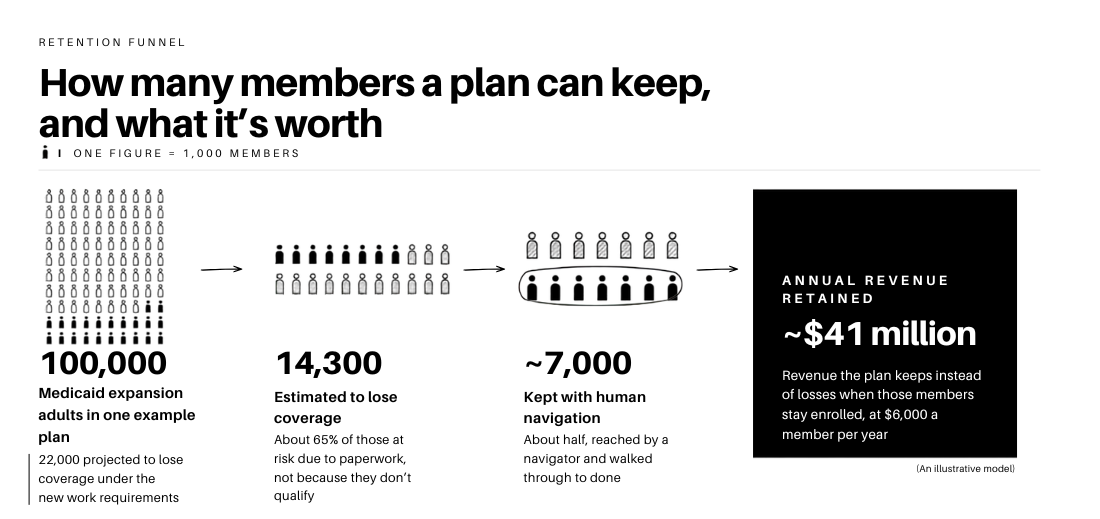
That’s the gap a navigator can close. When a navigator reaches those members and walks them through the necessary steps to demonstrate that they are qualified, your health plan holds onto thousands of members who would otherwise have dropped off. In this case, that could have been nearly 7,000 individuals who were eligible the whole time.
What a plan is paid varies widely by state and population, but in this example Medicaid pays the plan about $6,000 a year for each member it covers. Keep 7,000 of them, and that’s roughly $41 million the plan holds onto instead of losing.
You can argue with the exact figures, and you should. Maybe fewer of your losses come down to paperwork. Maybe your team reaches fewer people in the hardest counties. Dial those assumptions down, and the total moves with them. But what doesn’t change is the takeaway.
Even a fraction of that revenue is worth far more than the work costs. You don’t have to be right about every number. You just have to reach the people the paperwork is about to lose.
The upfront payoff.
What makes this strategic investment unique is that it keeps eligible members enrolled upfront, rather than resting on savings only realized years later.
The evidence for those savings is real and convincing: our work with Elevance Health was the basis of an NEJM Catalyst study showing a $181 PMPM reduction for members with combined clinical and social risk (Elmor et al., 2026). The difference is you don’t have to wait years, or trust a projection, to see this one pay off. Keeping eligible members covered shows up immediately.
We’ve watched this happen. When pandemic protections ended, the plans that waited spent months chasing members who’d already lost coverage. Winning someone back is harder than keeping them. It costs more, takes longer, and often fails.
It’s also worth seeing work requirements for what they are: one item on a much longer list. The same members facing an 80-hour reporting rule are managing transportation, food insecurity, housing instability, and other needs that move in and out of their lives on their own schedule.
A foundational build to grow on.
A plan that stands up navigation infrastructure for this January deadline isn’t building for a single rule. It’s creating the capabilities it will reuse for everything else on that list.
The practical first step is determining two numbers:
· What is your projected disenrollment underwork requirements in each of your states?
· How much of that projection is administrative rather than eligibility-based?
· Who inside your organization owns that total today?
If those numbers are significant, and for health plans both most likely will be, and if nobody owns it yet, that finding lays the foundation for developing a strategy to retain members and revenue.
For your specific states and enrollment, let’s map how many members you can keep, and what it's worth to keep them.
Capitation and per-member figures in this article are illustrative and drawn from public analysis of Medicaid enrollee spending. They do not reflect any specific plan’s rates. Implementation dates reflect current federal requirements and public state announcements as of publication and are subject to change.